When a site operator asks whether to automate a route, the question is never “is autonomy possible?” On a private site with fixed routes and low speeds, that question was answered years ago. The question is: “does the math work?” And the math is more ordinary, and more favorable, than most operators expect.
The cost structure you have today
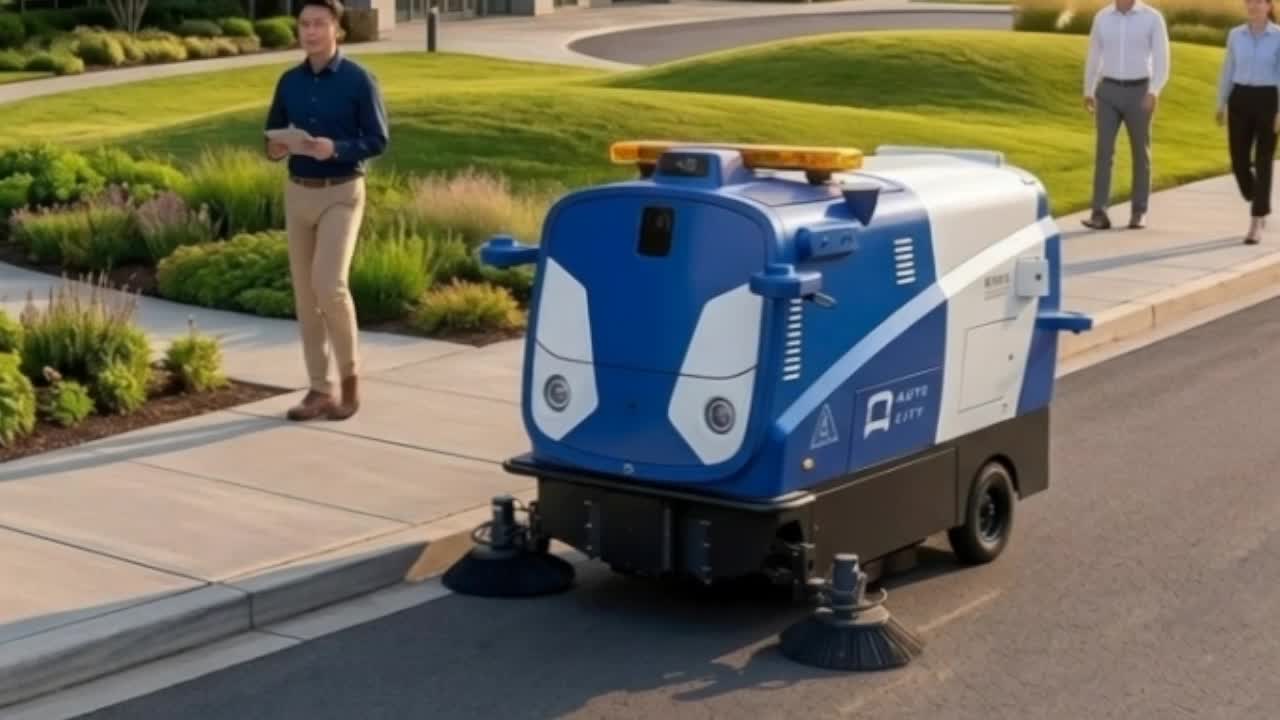
Consider the three jobs we discussed in our applications overview: sweeping, patrol, and tug runs. Each one carries the same three costs.
Labor. Someone drives the vehicle, on every shift, including the 4 a.m. sweep and the overnight patrol. Wages are rising, and these roles turn over. Every departure restarts training, and every unfilled shift is service that quietly stops happening.
Utilization. A sweeper bought for eight hours of work per day spends the other sixteen parked. Night and off-peak scheduling would raise utilization, but you cannot staff it, so the asset sleeps.
Consistency. The quality of a swept lot or a completed patrol depends on who showed up. Two operators run the same route differently. Auditing that consistency is a supervisor’s time.
What changes when the vehicle drives itself
Autonomy attacks all three lines, in order of visibility:
- Shift coverage without headcount. The 4 a.m. sweep and the overnight patrol stop competing for labor. The difficult hours become the preferred hours, because robots do not mind them.
- Off-peak scheduling. Utilization climbs when the vehicle can work whenever the site is empty. The same capital buys more work.
- Consistency by construction. The route, the speed, the pause points, and the camera positions are declared in a map. The thousandth run is as consistent as the first, and the audit trail is the map itself.
The vehicle is the easy part to buy. What you are actually adopting is a new operating discipline: the site’s rules live in a map, and the fleet executes that map exactly.
The line item everyone forgets
Here is where naive ROI models fail. They budget the vehicle, the integration, and the first map. They forget that the site keeps changing.
Harbor Yard, the illustrative depot we use throughout the HD Map Handbook, shows the failure in miniature. Six months after mapping, a new container pad extended the pavement by 80 centimeters. The lanelet boundary still followed the old curb. The vehicle was not broken; it was perfectly centered in a lane that no longer existed, hugging an edge no operator could explain. Three weeks of that, and the site’s trust in automation erodes faster than the paint.
The fix was one map edit. The lesson is a budget line: map maintenance is an operating cost, not a one-time purchase. A deployment’s ROI lives or dies on how cheaply the map stays true: how fast a scan becomes an updated map, how safely an edit ships, and how little expert time the loop consumes. When you evaluate autonomy vendors, evaluate that loop first. The vehicle will be fine.
The realistic frame
No site should automate everything on day one. The pattern that works:
- Pick one route with measurable throughput (a sweep loop, a patrol circuit, a tug run between two docks).
- Map it, validate the map, and run the route beside the human process for a few weeks.
- Measure: shifts covered, service consistency, incidents traced to map errors versus vehicle errors.
- Expand only when the map-maintenance loop is boring. Boring is the goal. Boring scales.
Every job on that list starts with the same artifact: a trustworthy map of the site. That is the product we are building, and the Handbook is the reference for what “trustworthy” means, chapter by chapter.